Why Solar Leads Go Cold And How to Fix Your Appointment Setting, Close Rate and Conversion in 2026
You paid for the lead. The homeowner filled out the form. And then nothing no answer on the phone, no reply to your texts, and another $150 wasted.
If this is happening regularly, the problem is almost never your price or your panels. It comes down to three things: how fast you respond, how well you qualify solar leads upfront, and how tight your solar appointment setting process is after first contact.
In 2026, the average homeowner gets quotes from 3 to 5 solar companies before making a decision. The company that responds first, qualifies cleanly, and books a confirmed appointment wins the deal regardless of price. This guide gives you the full picture: why solar leads go cold, what your solar sales close rate and sit rate should actually look like, and the exact steps the top-performing installers are taking to fix their conversion numbers right now.
TABLE OF CONTENTS
1. What Are the Real Solar Sales Benchmarks in 2026?
Before fixing anything, you need to know what good looks like. Here are the numbers that matter and that most owners either do not track or do not know.
• Solar lead conversion rate (lead to closed sale): The industry average sits at 8-12%. Top-performing companies with fast response systems and structured solar appointment setting consistently achieve 15% or higher. If you are below 8%, the problem is almost certainly in your response time and qualification process not your closing ability.
• Solar sales close rate (appointment to closed sale): Once a homeowner actually sits down for a consultation, the average close rate is 25-35% for well-qualified appointments. For unqualified appointments where the setter skipped proper qualification that number drops to 8-15%. This is why learning how to qualify solar leads before booking is not just a nice-to-have; it is the difference between a profitable and unprofitable sales operation.
• Solar lead sit rate (appointments booked to appointments kept): The industry benchmark for sit rate the percentage of booked appointments where the homeowner actually shows up is 65-75% with a proper double confirmation process. Companies without a confirmation sequence see sit rates as low as 40-50%, meaning nearly half of every appointment your setter books simply does not happen.
• Solar lead response time: Only 7% of solar companies respond to a new lead within 5 minutes of submission. The average response time across the industry is over 40 hours. That is not a typo. By that point, the homeowner had moved on entirely.
Here is how those numbers connect:
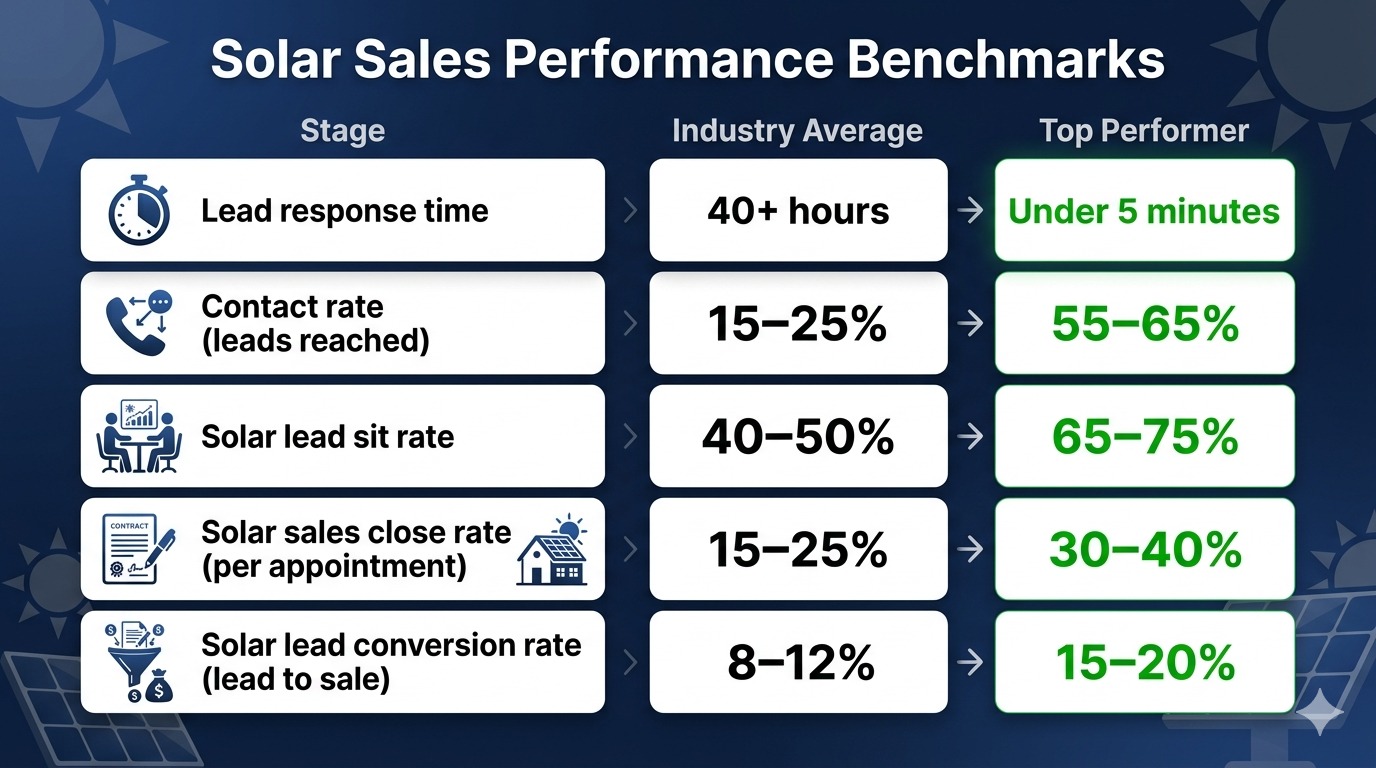
The gap between average and top performer is not talent. It is systems.
2. Why Solar Leads Go Cold: The 3 Core Problems
Understanding why solar leads go cold is the first step to fixing your numbers. There are three structural reasons and none of them are about the homeowner's intent.
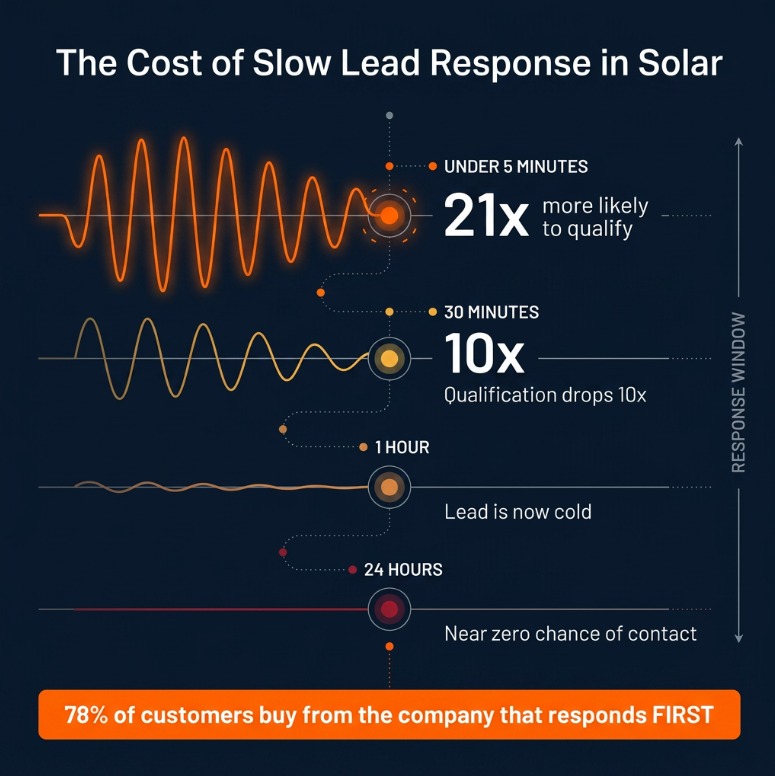
• Problem 1: Solar Lead Response Time Is Far Too Slow: When a homeowner submits a solar quote form, they are at peak interest at that exact moment. Research by Dr. James Oldroyd at MIT, published in the Harvard Business Review, tracked 1.25 million sales leads and found that companies contacting a lead within 5 minutes were 21 times more likely to qualify that lead than companies that waited 30 minutes. By the one-hour mark, the lead is effectively cold regardless of how interested they were when they hit submit. This is not a theory. It is the single most replicated finding in sales research, and it is the main reason solar leads go cold before your team even has a chance. The brutal math: if your current solar lead response time is 3-6 hours which is common for teams without automation you are reaching out to leads who have already spoken to two or three competitors, barely remember which website they used, and are no longer in the mindset where a call from a stranger about solar feels timely or relevant.
• Problem 2: The After Hours Gap: A large share of inbound solar leads arrive outside business hours specifically Thursday to Sunday evenings between 7 PM and 11 PM. This is when homeowners are relaxed and actually have time to research a big purchase decision. It is also exactly when your setter team is offline. By Monday morning, a Saturday night lead has been sitting for 36-48 hours. Whatever intent drove them to fill out that form has faded. Your solar lead response time at that point is essentially meaningless. This is the after-hours gap and it is one of the most overlooked drains on solar lead conversion rate for mid-sized installers.
• Problem 3: Poor Qualification Is Destroying Your Sit Rate and Close Rate: Many solar companies are so focused on booking appointments that they skip proper lead qualification entirely. The result is a full calendar that produces almost no revenue: homeowners who are renters, have bad credit, have an unsuitable roof, or were never serious buyers in the first place. When you do not know how to qualify solar leads before booking, three things happen. First, your solar lead sit rate collapses homeowners who were never that interested simply do not show up. Second, your solar sales close rate tanks closers waste hours with people who cannot or will not buy. Third, your setters burn out faster, because every wasted appointment feels demoralizing on top of an already difficult job. Knowing how to qualify solar leads is not about rejecting prospects it is about protecting your team's time and your company's margins.
3. How to Qualify Solar Leads: The 6 Questions That Save Your Pipeline
One of the most searched topics among solar sales managers is how to qualify solar leads without being so aggressive upfront that you lose prospects who were genuinely interested. The answer is a short, natural qualification conversation not an interrogation.
These six questions should happen in the first two minutes of every first contact, whether human or AI:
1. Do you own the home? Renters cannot install solar. This eliminates a large percentage of unqualifiable contacts immediately.
2. What is your average monthly electricity bill? Under $80-100/month usually means solar economics do not make sense for the homeowner. Over $150/month is a strong signal.
3. What type of roof do you have, and how old is it? Flat roofs, very old roofs, and heavily shaded roofs create installation problems that affect whether a deal is viable.
4. Are you the decision-maker, or is there a spouse or partner who would be part of this conversation? Booking appointments where only one decision-maker is present is a leading cause of low solar lead sit rate. Both people need to be at the consultation.
5. Are you looking to move forward in the next 30-90 days, or is this more of a longer-term exploration? This surfaces intent level without being pushy.
6. Have you had any solar consultations already? Knowing where you sit in the prospect's process helps your closer frame the conversation correctly.
A six-question qualification process like this removes 40-60% of unqualifiable contacts before they ever reach your closer which is exactly what the data says it should do.
4. How to Increase Solar Appointments: 5 Strategies That Work in 2026
• Strategy 1: Fix Your Solar Lead Response Time First: Before any other change, close the time gap. Pull 90 days of CRM data and calculate your average time from lead submitted to first contact attempt. Most teams that do this find their average is hours, not minutes. The target for fresh inbound leads: under 5 minutes during business hours, under 30 minutes at all other times. This single change just closing the response time gap can double your contact rate, which is the foundation of everything else. Start with your CRM routing. Many solar companies are losing 30–90 minutes just because leads are being batch-assigned each morning rather than pushed to a setter's phone the moment they come in. Real-time routing costs nothing to configure in most CRMs including JobNimbus, HubSpot, Salesforce, and Sunbase and it is the fastest free fix available.
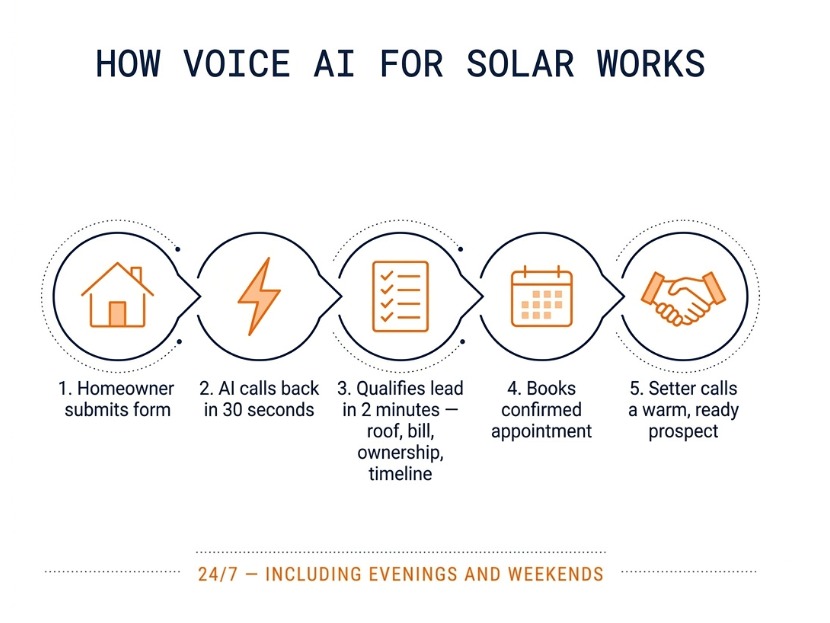
• Strategy 2: Use AI Solar Lead Follow Up to Cover the After-Hours Gap: The most significant operational shift among top-performing solar companies in 2026 is using AI solar lead follow up for the initial first touch not to replace setters, but to ensure that every lead receives contact within minutes, at any hour. An AI voice agent calls a new lead within 30 seconds of form submission. It confirms interest, runs through the six-question qualification checklist, and books a callback slot for your human setter. By Monday morning, instead of a pile of cold weekend leads to dial through, your setter team opens a calendar of warm, pre-qualified appointments. This is where the contact rate jump happens. Companies using AI solar lead follow up for first touch consistently move from 15–20% contact rates to 55–65% because they are no longer missing the entire after-hours window where solar leads are most likely to come in. Tools like Jinn Live are purpose-built for this use case in solar, with pre-built qualification scripts, CRM integrations, and 24/7 availability. The key mental model: AI handles speed and availability, humans handle relationships and closing.
• Strategy 3: Double-Confirm Every Appointment to Protect Your Sit Rate: Booking the appointment is only half the job. A confirmed appointment on Monday that the homeowner skips on Friday is a wasted slot, a wasted closer's time, and a demoralized setter. Top-performing solar appointment setting operations use a double-confirmation process: Immediately after booking: SMS confirmation with appointment details and what to have ready (a recent electricity bill, knowledge of roof age) 24 hours before: Phone or SMS reminder that also re-confirms both decision-makers will be present 2 hours before: Final SMS reminder This process alone can lift your solar lead sit rate from the 40-50% average to 65-75% or higher. The homeowner feels like a priority rather than an afterthought, and the additional touchpoints surface cancellations early enough to fill the slot with another appointment.
• Strategy 4: Solar Setter Tips That Actually Reduce Burnout: Solar setter burnout is a structural problem, not a motivation problem. The average setter makes 80–120 dial attempts per day. At that volume, with a high rejection rate, most setters last fewer than 60 days before performance drops or they leave. The solar setter tips that make the biggest difference are not motivational they are operational: Remove the dead-end dials. Unqualified or duplicate leads eat time and morale. The better your upfront lead qualification, the fewer useless dials your setters make. Let AI handle the no-answers. If a lead does not pick up, an automated SMS and follow-up call sequence can run without a setter touching it freeing them for live conversations only. Set a clear handoff SLA. Setters should know exactly what a qualified appointment looks like and should not be penalized for declining to book a clearly unqualifiable prospect. Track sit rate per setter, not just appointments booked. A setter booking 30 appointments with a 40% sit rate is doing less useful work than one booking 15 appointments with a 75% sit rate. Sit rate is the real quality metric. When setters spend their time on real conversations with qualified prospects, burnout drops, tenure increases, and your whole pipeline becomes more predictable.
• Strategy 5: Build a 4-Day Multi-Touch Follow-Up Sequence: One of the simplest solar setter tips that is consistently underused: most leads need more than one or two attempts before they pick up. Industry data puts the average number of contact attempts before reaching a prospect at 5-7. Most solar companies give up after 1-2. A structured sequence for every new lead: 0–5 minutes: First call (AI or setter) 2 minutes after first call: Automated SMS with a short intro and booking link 1 hour: Second call attempt 4 hours: Follow-up SMS Day 2: Third call plus email Day 4: Final attempt a short "closing the loop" message that gives the lead a low-friction way to re-engage or opt out This sequence improves contact rates significantly compared to a one-or-two call approach, while keeping the process automated enough that it does not fully depend on setter availability.
5. Frequently Asked Questions
• Why do solar leads go cold so fast? Because homeowner intent is at its peak the moment they submit the form and decays within minutes. Research shows that waiting just 30 minutes to respond makes you 21 times less likely to qualify a lead compared to calling within 5 minutes. By the time most solar teams call often hours or the next day the homeowner has mentally moved on or been contacted by a faster competitor.
• What is a good solar sales close rate? For well-qualified appointments, a strong solar sales close rate is 30-40%. The industry average for all appointments, including unqualified ones, is 15-25%. If your close rate is below 15%, the most likely cause is poor upfront qualification your closers are sitting with too many homeowners who cannot or will not buy.
• What is a good solar lead sit rate? With a double-confirmation process, top performers achieve a solar lead sit rate of 65-75%. Without any confirmation process, sit rates drop to 40-50%. Every no-show is a wasted closer slot, so sit rate is one of the highest-leverage metrics to improve in the whole sales funnel.
• How do I increase solar appointments without hiring more setters? The fastest way to increase solar appointments without adding headcount is combining AI solar lead follow up for first touch with a proper qualification process. AI covers the after-hours gap and ensures no lead goes uncontacted, while better qualification means the appointments that do get booked are more likely to show up and buy.
• What are the most important questions when qualifying solar leads? The six key questions to qualify solar leads are: homeownership status, monthly electricity bill, roof type and age, presence of all decision-makers, purchase timeline, and prior solar consultations. These six questions, asked naturally in the first two minutes of contact, eliminate the majority of unqualifiable prospects before they reach your closer.
6. The Bottom Line
Your solar lead conversion rate, your solar lead sit rate, and your solar sales close rate are all connected and they all trace back to the same three fundamentals: how fast you respond, how well you qualify solar leads upfront, and how tight your solar appointment setting process is from booking to consultation.
Speed is a system. Qualification is a system. Solar appointment setting is a system. When all three work together, your numbers move.
"Stop letting solar leads go cold after hours.Book a free demo
to see how AI lead follow up covers the after-hours gap, qualifies leads in under 2 minutes, and books confirmed appointments directly into your team's calendar 24/7."

About Jinn Insights
Jinn Insights studies what happens in real sales conversations on the retail floor. Our insights come from showroom, test drive and follow-up conversations captured by Jinn and scored from greeting to close.
Share Your Thoughts
Join the conversation and let us know what you think