How In-Store Voice Intelligence Is Eliminating Guesswork in Jewellery Retail Operations

TABLE OF CONTENTS
1. Jewellery Retail Has Always Run on Gut Feel
There is a version of jewellery retail management that most owners know intimately. It is the version where decisions get made on the basis of experience, instinct, and accumulated observation. Where the answer to "why did that week underperform?" is usually some combination of the weather, the economy, and a general sense that things were a bit slow.
Where inventory decisions are driven by what sold well last year, what looked strong at the trade show, and what the supplier is pushing this season. Where training programs are built around what the most experienced person on the team believes works, rather than what the data shows actually does. Where marketing budgets are allocated based on a rough sense of what feels like it is working rather than evidence of what is actually driving customers through the door.
This is not a criticism of how jewellery retailers have operated. For most of the industry's history, this was the only option available. The data that would have made better decisions possible simply did not exist in a form that anyone could access and act on.
That is no longer true.
2. Why Inconsistency Is So Hard to Diagnose Without Conversation Data
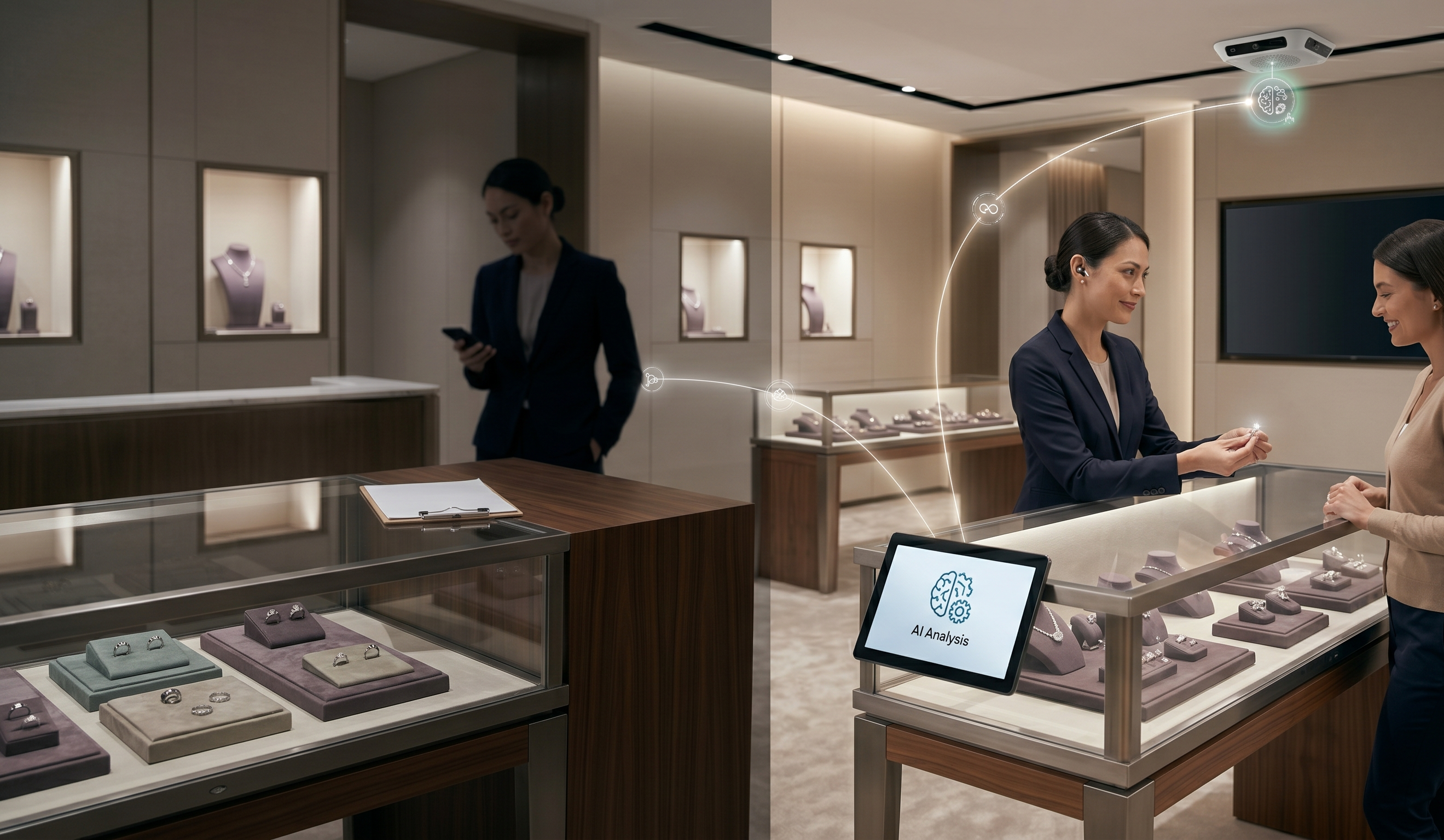
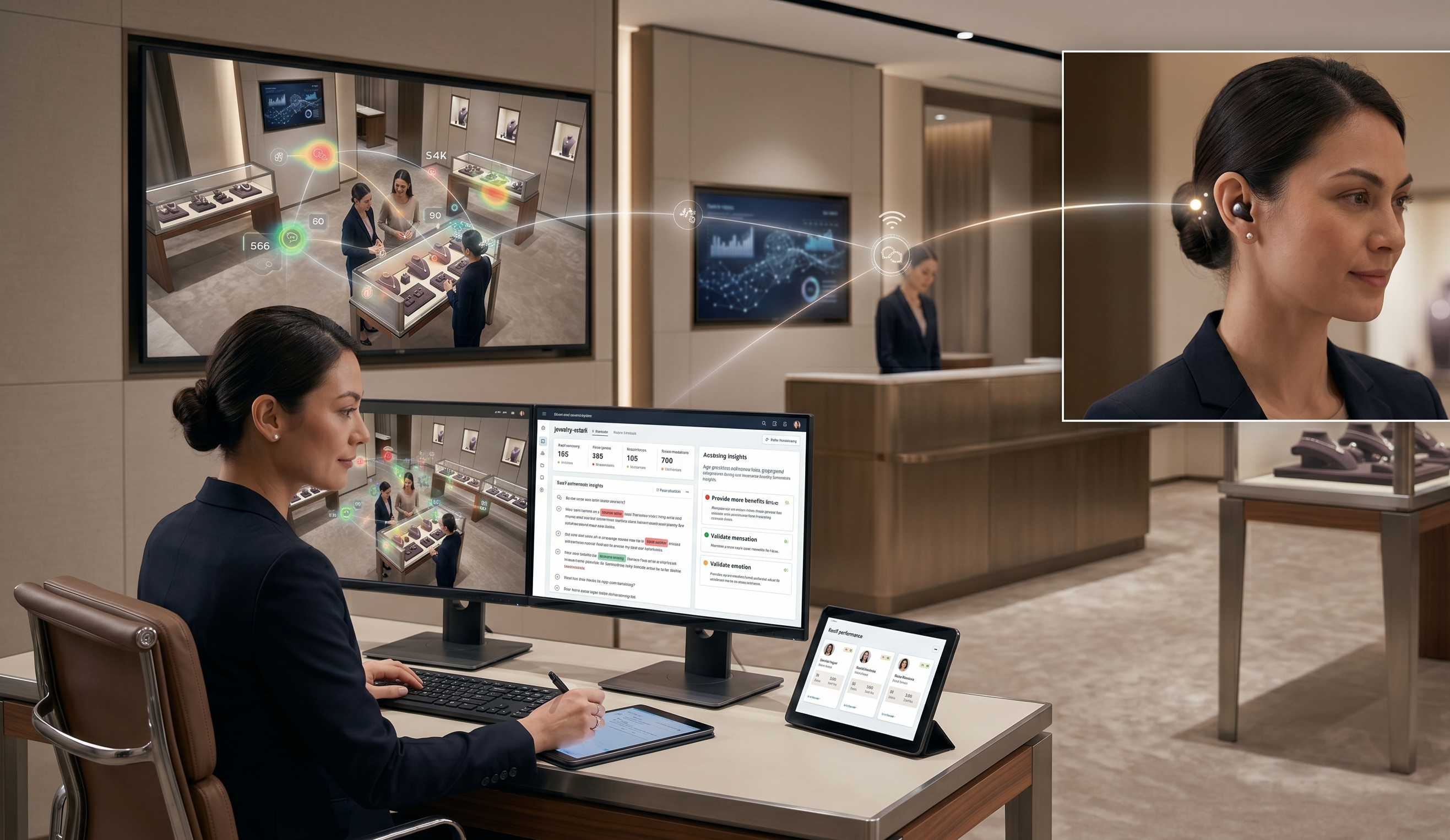
In-store voice intelligence does not just improve sales performance. It changes the information available for every major operational decision a jewellery retailer makes. Here is where that impact is most significant.
• Staffing and Scheduling: Most jewellery retailers schedule staff based on historical footfall patterns. Busy periods get more cover. Quiet periods get less. It is a reasonable approach, but it misses a crucial variable: conversation quality varies across different associates, and deploying the wrong associate during a high-opportunity period can cost more in lost sales than having slightly fewer staff on the floor. Conversation intelligence adds a performance dimension to staffing decisions. A manager who knows which associates consistently produce the strongest conversion rates can schedule accordingly, ensuring that the busiest and highest-value periods are covered by the team members most likely to capitalize on them. Beyond individual performance, conversation data also reveals time-of-day patterns in conversation quality across the team. If the data shows that discovery conversations are consistently weaker during the lunch rush because associates are moving too quickly, the scheduling response is not just more staff. It is also targeted coaching for that specific context before the problem repeats.
• Training Investment: Without conversation data, training investment in jewellery retail is largely undirected. A store owner invests in product knowledge training because it seems useful. They bring in a sales coach because a few associates seem to be struggling. They run a team session on customer experience because a mystery shopper report flagged some concerns. These investments are not wasted. But they are not optimized either, because they are not targeted at the specific conversational gaps that are actually driving performance problems. Conversation intelligence changes that. Training investment can be directed precisely at the skills gaps the data identifies. If the platform shows that the primary driver of non-conversion across the team is weak objection handling in the mid-conversation phase, that is where training resource goes. Not into a general customer experience refresher, but into a targeted program that addresses exactly the issue costing the store money. The result is training that produces measurable, specific improvement rather than a general uplift that is hard to connect to any particular outcome.
• Floor Layout and Merchandising: This is one of the less obvious but commercially valuable applications of in-store conversation intelligence in jewellery retail operations. Conversation data reveals which product categories and specific pieces are generating the most customer interest and enquiry, even when that interest does not convert to an immediate purchase. It surfaces the items that customers engage with most enthusiastically, the price points that generate the most conversation, and the product gaps where customer demand is going unmet. That intelligence has direct implications for floor layout and merchandising decisions. Products that are generating strong conversational interest but weak conversion may be in the wrong position on the floor or being presented in a way that does not reflect what customers find compelling about them. Moving them or changing how associates introduce them can unlock the sales that the interest already justifies. Products that are rarely mentioned in customer conversations despite being prominently displayed may be taking up valuable floor space that higher-demand items should occupy. This is insight that no POS report can provide, because the POS only records what sold, not what customers were interested in.
• Inventory and Buying Decisions: The most direct operational application of conversation intelligence is in inventory management and buying decisions, and it is one of the most transformative. Every day, customers in your store ask for things you do not stock. A specific style they saw on social media that your current range does not include. A price point you are not currently serving well. A product category you carry but in a limited way that does not reflect the actual demand you are experiencing. Those requests are demand signals. In most jewellery stores, they disappear the moment the conversation ends. The associate apologizes, suggests the nearest alternative, and moves on. The buyer never hears about it. When conversation intelligence captures those signals systematically across every customer interaction, the picture that emerges is one of the most valuable inputs a jewellery buyer can have. Real, current, specific demand data from the people who are actually walking into the store and wanting to spend money. Buying decisions informed by that data produce ranges that are more precisely aligned with actual customer demand. Fewer items sit in cases for months without selling. More items generate immediate interest because they reflect exactly what customers have been asking for. Stock turnover improves. Return on buying investment increases.
3. Replacing Assumption With Evidence Across the Business
The common thread running through all of these operational applications is the replacement of assumption with evidence.
Jewellery retail has always required its operators to make dozens of decisions each week with incomplete information. Which products to push this month. Which associates need the most support right now. Where the marketing budget should go next quarter. What the customer experience needs that it does not currently have.
In the absence of better information, those decisions have been made on the basis of experience, observation, and instinct. And experienced jewellery retailers develop good instincts. But instinct has limits. It is shaped by what was noticed and remembered rather than the full picture of what happened. It is subject to bias. And it cannot detect the subtle patterns that sit across hundreds of conversations and only become visible at scale.
In-store voice intelligence fills that gap. It does not replace the judgement and experience of a skilled jewellery retail operator. It gives that judgement better information to work from.
The decisions do not change in nature. The same calls still need to be made about staffing, training, inventory, and experience. What changes is the quality of the evidence those decisions are built on.
4. The Operational Advantage of Knowing What Is Actually Happening
There is a competitive dimension to this that is worth naming directly.
Every jewellery retailer in your market is making the same kinds of operational decisions you are. Most of them are making those decisions with the same limited information you currently have access to. Footfall data. POS records. Staff observation. General market intelligence.
The retailer who adds conversation intelligence to that information set is making those decisions from a fundamentally stronger position. They are not smarter or more experienced. They simply know more about what is actually happening in their store every day.
Over time, that knowledge advantage compounds. Better-informed decisions produce better outcomes. Better outcomes create better data. Better data informs even sharper decisions. The gap between the retailer operating on evidence and the retailer operating on instinct grows wider with every passing month.
In a competitive jewellery retail market, that gap eventually becomes decisive.
5. Operations Built on What Is Actually True
The promise of in-store voice intelligence for jewellery retail operations is not complexity. It is clarity.
Clarity about what is working and what is not. Clarity about where customers are going unserved. Clarity about which associates need support and in what specific areas. Clarity about what your customers are actually asking for and what your buying decisions should reflect.
That clarity does not eliminate the difficulty of running a jewellery retail business. But it does ensure that the effort you put into improving your operations is directed at the right problems, informed by real evidence, and likely to produce the results you are working toward.
"Running a jewellery store on gut feel has always worked to a point. In-store voice intelligence is what takes you beyond that point."
"Want to see how in-store voice intelligence gives your jewellery retail operations a foundation of real evidence?Book a free demo
and we will walk you through what it reveals about your store."

About Jinn Insights
Jinn Insights studies what happens in real sales conversations on the retail floor. Our insights come from showroom, test drive and follow-up conversations captured by Jinn and scored from greeting to close.