Why Most In-Store Sales Conversations End Without a Purchase
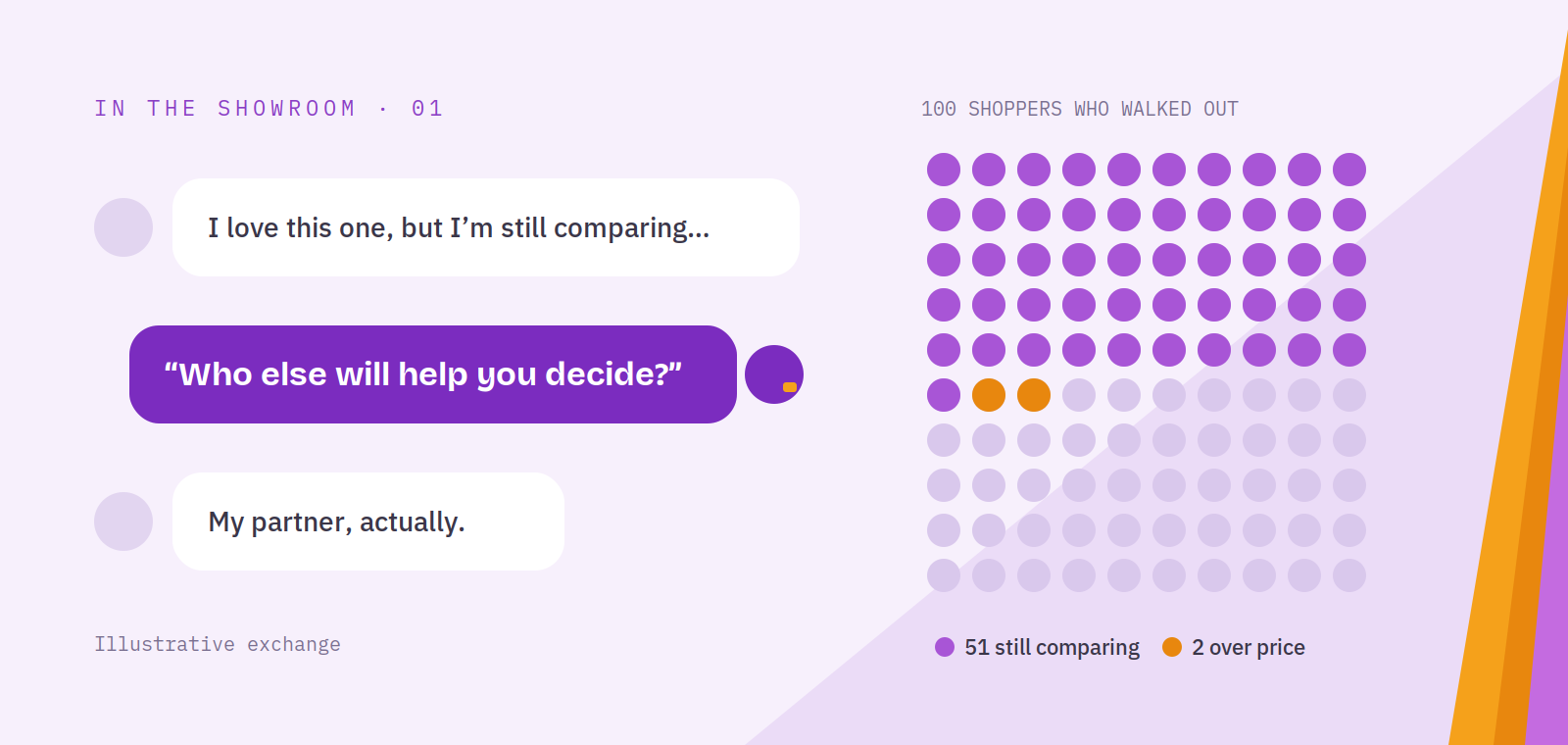
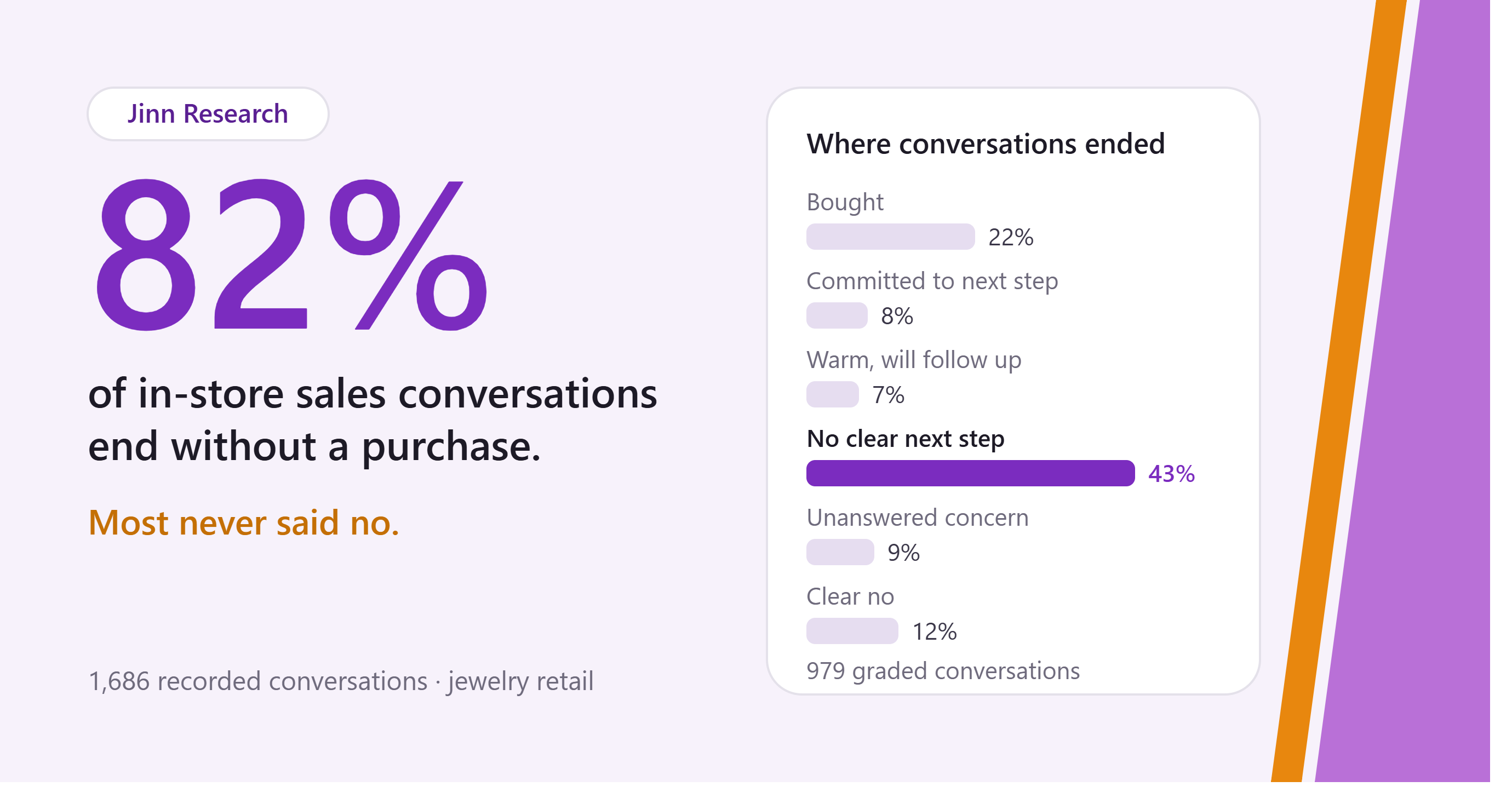
82 in 100 shoppers left without buying. Most never said no. Findings from 1,686 recorded sales conversations across jewelry brands, and what they mean for your sales floor.
Retailers measure who walks in and what gets billed. Almost nobody measures the conversation in between.
That conversation is where the sale is won or lost. We recorded 1,686 of them between store associates and shoppers across jewelry brands, and graded how each one ended. This post covers what we found.
TABLE OF CONTENTS
1. Key takeaways
- Four in five conversations end without a sale. 82% across brands (95% CI: 80–84%).
- Most lost sales aren’t a “no.” 43% of shoppers left with no appointment, follow-up or recorded reason.
- One in seven leaves warm. 14% agreed to come back or asked for a quote.
- Conversation quality tracks conversion. Strong conversations converted at 35%; weak ones at 2%.
2. What we listened to
Sales associates wore Jinn badges on the floor. Every conversation was transcribed and scored across nine stages, from the greeting and discovery through price, objections and the close. We also graded how each visit ended, on six levels from “bought” to “clear no.”
3. Five things the data shows
FINDING 01Four in five conversations end without a sale
Most store leaders sense this number. What they can’t see is how those conversations ended.
All 1,686 conversations
FINDING 02Most lost sales aren’t a “no.” They just stop.
We graded every outcome. The largest group didn’t object or decline. They simply left.
A shopper who leaves without a next step hasn’t said no. They just haven’t been helped to say yes.
FINDING 03One in seven shoppers leaves warm
These sales are only recoverable if the store remembers what each shopper asked for.
FINDING 04How the conversation goes decides the sale
We scored every conversation on how it was handled, then compared conversion across score bands.
Strong conversations converted at nearly double the 18% average. Conversations that needed coaching almost never did.
FINDING 05It holds when you compare like with like
Longer conversations and eager shoppers convert more on their own. So we tested the score where those are equal.
How often does the score rank the buyer above a non-buyer?
A coin toss would score 50 in 100. All tested on conversations the model didn’t learn from.
4. What this means for your stores
Three places to start:
Treat “no next step” as a coaching gap. Most lost sales weren’t lost to price or a competitor. They ended without an ask.
Work the warm list. Nearly 1 in 5 shoppers who didn’t buy left open to coming back. Knowing what each asked for turns a follow-up into a sale.
Measure the conversation, not just the outcome. Once every conversation is recorded and scored, you can see which ones go wrong, and where.
5. A note on the numbers
Data. 1,686 in-store sales conversations between associates and shoppers across jewelry brands, 2026. Order pickups and duplicates excluded.
Scoring. Each conversation is recorded on a wearable badge, transcribed, separated by speaker and scored against nine stages of a consultative sale.
Validation. Stage weights are learned from what separates purchases from non-purchases of similar length, then tested only on held-out conversations. AUC is 0.73 across brands (95% CI 0.70–0.77 on the largest sample), 0.69 within similar-length conversations, 0.65–0.75 within buying-intent bands and 0.72 on a forward time split. 0.5 = chance.
Intervals. Conversion by score band uses the full dataset, with Wilson 95% intervals. The held-out AUC figures are the stricter test.
6. Coming up in the series
Over the next few weeks, we’ll look at how conversations are scored, and how to make that scoring fair.

About Jinn Research
Jinn Research studies what happens in real sales conversations on the retail floor. Our insights come from showroom, test drive and follow-up conversations captured by Jinn and scored from greeting to close.
Share Your Thoughts
Join the conversation and let us know what you think