Stop Guessing Why Your Jewellery Sales Are Inconsistent: AI Has the Answer
TABLE OF CONTENTS
1. The Most Frustrating Problem in Jewellery Retail
Ask any jewellery store owner what keeps them up at night and inconsistency will be near the top of the list.
Not the bad weeks. Bad weeks have explanations. A quiet period after the January sales rush. A competitor opening nearby. Unusually low footfall. Those things are explainable and, to some degree, manageable.
The real frustration is the unexplained inconsistency. The Tuesday that produces three times the revenue of the Wednesday that follows it. The associate who closes brilliantly one week and struggles the next. The month that starts strongly, loses momentum in the middle, and finishes in a way that leaves everyone slightly puzzled.
You review the numbers. You look for patterns. You ask the team what they think happened. And most of the time, nobody really knows. The explanations are vague. The decisions about what to change are based more on hope than evidence.
This is what it feels like to run a jewellery store without visibility into what is actually happening in your customer conversations.
2. Why Inconsistency Is So Hard to Diagnose Without Conversation Data
Sales inconsistency in jewellery retail almost always has its roots in the conversation. Not in foot traffic fluctuations, not in product range gaps, not in pricing, though all of those can be contributing factors. The primary driver of inconsistent performance is inconsistent conversational quality across associates, shifts, and days.
The challenge is that without conversation data, this is nearly impossible to diagnose with any precision.
A manager looking at revenue figures can see that performance dropped on Thursday afternoon. But the numbers cannot tell them whether that drop happened because the associate who was on shift failed to surface customer motivation early in conversations, or because a recurring objection about price came up four times and was handled poorly each time, or because the closing approach being used that afternoon was creating resistance rather than removing it.
All of those causes require the same remedy at the surface level: better conversations. But they require very different coaching interventions to fix. And without knowing which one is actually responsible, the coaching is guesswork.
Guesswork-based coaching produces inconsistent results. Which perpetuates the inconsistency the manager was trying to fix in the first place.
3. The Inconsistency Patterns AI Identifies in Jewellery Retail
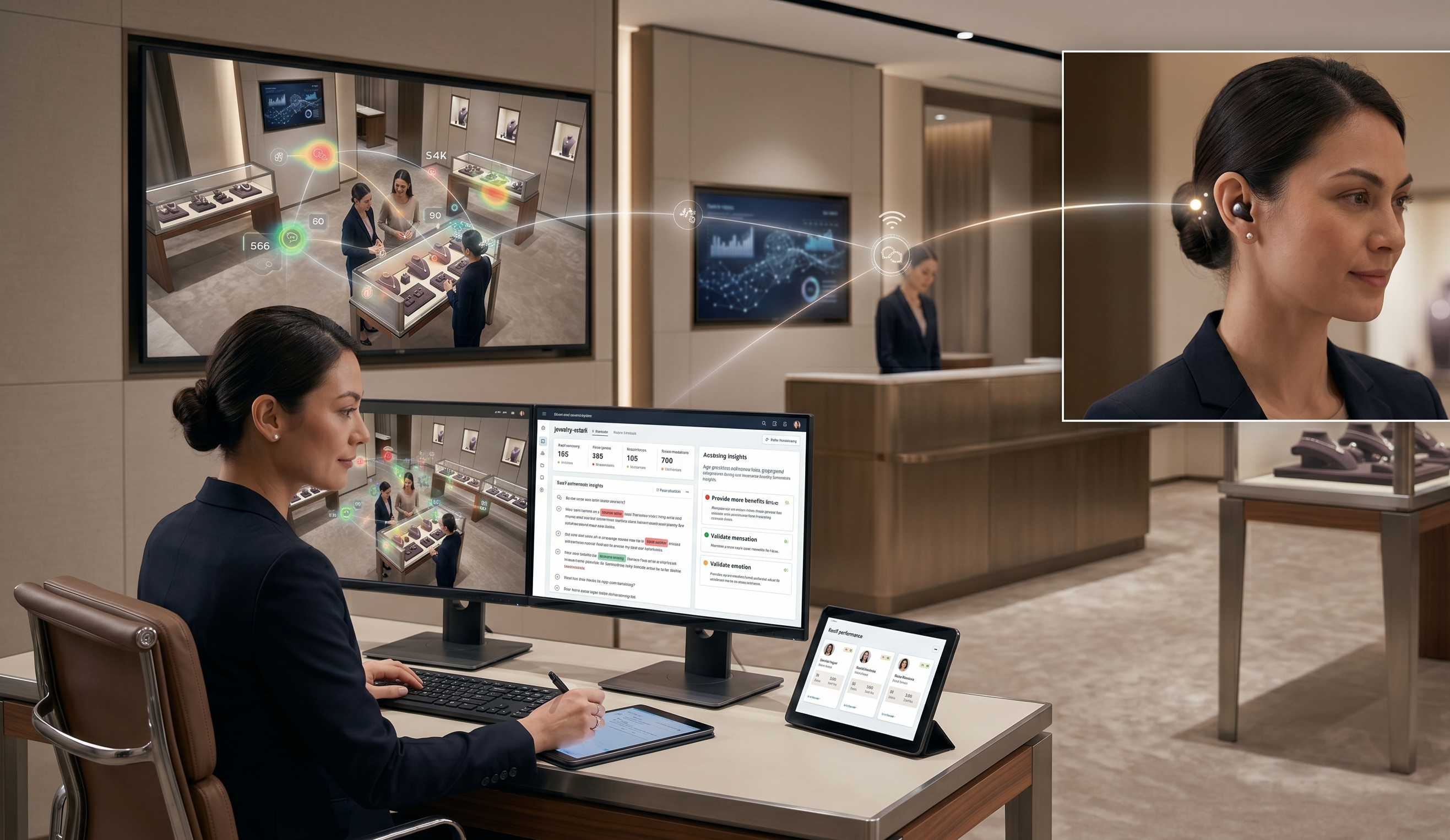
When an in-store voice intelligence platform begins analyzing conversations across a jewellery store, inconsistency patterns emerge quickly and fall into several recognizable categories.
• Associate-level inconsistency: The same associate performs very differently across different customer types or conversation contexts. They are strong with customers who come in knowing what they want but struggle with undecided browsers. They close confidently on lower-price items but become hesitant when a conversation moves into premium territory. These patterns are invisible in aggregate sales data but immediately visible in conversation analysis.
• Time-based inconsistency: Performance dips at specific points in the day or week, often in ways that do not correlate with foot traffic. A lunchtime rush that should produce strong results consistently underdelivers because associates are rushed and skip the discovery phase of the conversation. Friday afternoons underperform because energy on the floor drops and closing attempts become half-hearted.
• Product category inconsistency: Certain parts of the product range consistently under convert despite generating genuine customer interest. Conversation analysis reveals why. Associates are not presenting those products in a way that connects with what customers care about. The stories being told about those pieces are not landing. The objections that come up around specific categories are not being handled effectively.
• Experience inconsistency across associates: Two customers visit the store on the same day, speak to different associates, and have completely different experiences. One leaves with a purchase. The other leaves without one, not because they were less interested but because the conversation they had was less complete. This is the most commercially costly form of inconsistency in jewellery retail, and it is entirely correctable once you can see it.
4. From Diagnosis to Resolution
The reason in-store voice intelligence is so powerful as a tool for addressing sales inconsistency is not just that it identifies the problem. It identifies the problem precisely enough to fix it.
Traditional attempts to address inconsistency in jewellery retail tend to be broad. More training. Higher standards. Better product knowledge. Stricter management of the sales process. These interventions are not without value, but they are blunt instruments. They address the symptom rather than the specific cause, which is why the inconsistency often returns within weeks.
When conversation intelligence surfaces a specific pattern, the corrective action is equally specific.
If associate-level inconsistency is rooted in how a particular person handles undecided customers, the coaching intervention targets exactly that. Real conversation examples are used to show what handling that situation effectively looks like, and the associate practices the specific language and approach that the data shows works best.
If time-based inconsistency is rooted in associates skipping discovery questions during busy periods, the intervention addresses exactly that habit with exactly those associates during exactly those periods.
Specific diagnosis produces specific coaching. Specific coaching produces lasting change. And lasting change in conversational quality produces the consistent sales performance that jewellery store owners are looking for.
5. The Consistency Standard Your Best Days Already Demonstrate
Here is something worth considering. Your jewellery store almost certainly already has days, periods, or individual associates that demonstrate the level of consistent performance you are trying to achieve across the board.
Your best associate on her best day is already doing what you want the whole team to do every day. The conversation quality that produces your strongest sales periods is already present in your store. The techniques that close high-value sales consistently are already being used by someone on your team.
The inconsistency problem is not that excellence is absent. It is that excellence is not yet consistent.
In-store conversation intelligence identifies exactly what is happening on your best days and in your best conversations, and makes that the standard rather than the exception. It captures the approaches that produce strong results and builds them into how every associate works, on every shift, with every customer type.
The gap between your best performance and your average performance is a coaching gap, not a talent gap. And coaching gaps close when you have the right information to coach from.
6. What Consistent Performance Looks Like Over Time
Jewellery retail businesses that deploy in-store voice intelligence and use it consistently for coaching typically see their performance variance reduce significantly within the first few months.
The wild swings between strong and weak days begin to even out. Not because the strong days get weaker, but because the weak days get stronger. The floor performance that was previously dependent on which associate was working, what time of day it was, and how the conversation happened to go becomes more predictable and more reliably high.
Over time, that consistency compounds. A sales floor that performs at 80% of its potential consistently produces better results than one that alternates between 100% and 60%. Predictability is not just more profitable. It is also easier to manage, easier to staff, and easier to build a growing business around.
7. The Answer Has Been in the Conversation All Along
Every time your jewellery store has an inconsistent week, the reason is sitting in the conversations that happened during that week. Every time an associate underperforms, the explanation is in the specific interactions where things went wrong.
That information has always been there. The conversations have always been happening. The patterns have always existed.
The only thing that was missing was a system to capture them, analyze them, and turn them into the kind of precise, actionable intelligence that actually fixes the problem.
In-store voice intelligence is that system. It does not promise to eliminate every variation in your store's performance. But it does guarantee that you will never again have to guess why the inconsistency is happening or what to do about it.
"Inconsistency is not random. It has a cause. In-store voice intelligence helps you find it and fix it."
"Ready to stop guessing and start knowing exactly why your jewellery store performance varies?Book a free demo
and we will show you what your conversation data reveals."

About Jinn Research
Jinn Research studies what happens in real sales conversations on the retail floor. Our insights come from showroom, test drive and follow-up conversations captured by Jinn and scored from greeting to close.