How Jewellery Brands Are Increasing Average Transaction Value Using In-Store AI Insights
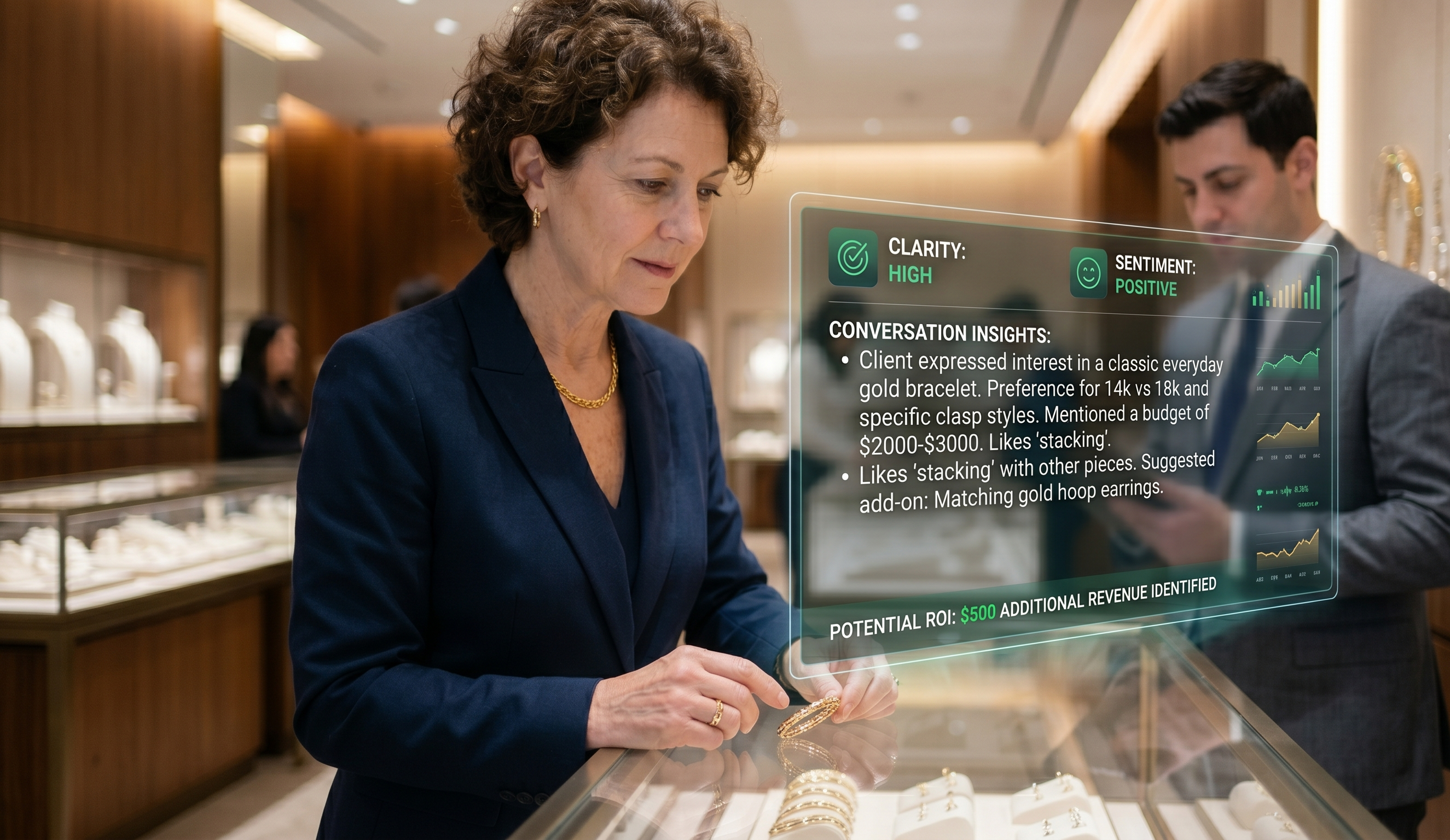
TABLE OF CONTENTS
1. The Metric That Matters Most in Jewellery Retail
Jewellery retail is unlike most other retail categories in one important respect. The ceiling on what a single customer can spend in a single visit is extraordinarily high.
A customer who walks in looking for a gift in the two hundred pound range can, with the right conversation, leave having spent eight hundred. A couple browsing engagement rings with a budget of two thousand pounds can, through a skilled and sensitive presentation of options, feel completely comfortable spending four thousand. A loyal customer who comes in for a simple repair can, through a warm and well-timed conversation about new arrivals, leave with a piece they did not know they wanted.
None of this requires pressure. None of it requires manipulation. It requires conversation intelligence. It requires associates who understand what the customer genuinely cares about and who can present options in a way that feels natural, relevant, and worth the stretch.
Average transaction value in jewellery retail is not primarily a product or pricing question. It is a conversation question. And it is one that in-store AI insights can help you answer far more consistently than you currently do.
2. Why Average Transaction Value Underperforms in Most Jewellery Stores
The gap between the average transaction value a jewellery store achieves and the average transaction value it is capable of achieving is almost always rooted in the same set of conversational shortcomings.
Associates present products at the price point the customer initially mentions rather than exploring what they might be willing to invest for the right piece. They interpret a budget as a ceiling rather than a starting point for understanding what the customer values. They are uncomfortable introducing higher-value options because they fear being seen as pushy, so they self-censor and steer toward the lower end of their range.
They miss the upsell moments that a more experienced associate would recognize and act on. The customer who is buying a necklace and mentions her husband's birthday next month. The customer who falls in love with a ring but hesitates on a matching band. The customer who asks about warranties and care, signaling they are thinking about the long-term ownership of the piece, which is exactly the moment to introduce a complementary item.
These moments happen on jewellery store floors every day. Most of them go unrecognized and unacted on. And most store owners have no visibility into how frequently those opportunities are appearing and disappearing.
3. What In-Store AI Insights Reveal About Transaction Value Opportunities
When an in-store voice intelligence platform analyses conversations across a jewellery store with transaction value in mind, what it typically surfaces is both revealing and immediately actionable.
• Where value conversations are being avoided: The platform identifies the points in conversations where an associate had the opportunity to introduce a higher-value option or a complementary product and chose not to. These are not moments of active failure. They are moments of passive omission, quiet decisions to stay safe rather than to explore what the customer might respond to. Making those moments visible is the first step to changing the behavior.
• Which customers are most receptive to premium options: Conversation analysis reveals the signals that indicate a customer has the appetite for a higher-value purchase, even when they have not stated it explicitly. The way they describe what they are looking for. The emotional weight they place on the occasion. The questions they ask about quality and longevity. Associates trained to recognize those signals can introduce premium options confidently and in a way that feels natural rather than opportunistic.
• The language that works when introducing higher-value pieces: Top-performing associates have specific ways of transitioning a conversation toward a higher price point that feel completely comfortable to the customer. They do not lead with the price. They lead with what makes the piece special, what it represents, and why it is worth considering. That language is identifiable in conversation data and it is teachable.
• Where upsell opportunities are consistently being missed: Pattern analysis across hundreds of conversations identifies the product combinations and customer contexts where complementary purchases are most likely to resonate, and where associates are currently failing to introduce them. That intelligence feeds directly into training programs focused on natural, appropriate upselling.
4. The Conversation Behaviors That Drive Higher Transaction Values
In-store conversation intelligence consistently identifies a set of behaviors that separate associates who achieve high average transaction values from those who do not. These behaviors are not innate talents. They are learnable skills.
• Anchoring with aspiration: High-performing associates do not start the product conversation at the customer's stated budget. They introduce aspirational options early, framing them as context for what is available rather than as a push to spend more. By establishing a higher reference point early in the conversation, they change the customer's frame of comparison for everything that follows.
• Connecting price to meaning: When a customer hesitates at a price point, the most effective response is not to justify the cost in terms of materials and craftsmanship alone. It is to connect the investment to what the customer has already said about the occasion, the person, or the significance of the purchase. The price stops being a number and becomes an expression of something the customer already values.
• Timing the introduction of complementary items: The right moment to introduce a second product is after the customer has made an emotional connection with the first one, not before. Associates who introduce complementary items too early create resistance. Those who time it correctly, after ownership thinking has set in, find that the conversation moves naturally toward a higher total purchase.
• Making the higher option feel accessible: The language associates use when presenting premium pieces significantly influences how accessible those pieces feel to the customer. Confident, matter-of-fact presentation of higher-value options normalizes the consideration of them. Tentative or apologetic presentation signals that the associate does not expect the customer to be interested, which becomes a self-fulfilling prophecy.
All of these behaviors are identifiable in conversation data. All of them are coachable. And all of them directly affect average transaction value.
5. The Cumulative Revenue Impact
The financial case for improving average transaction value through conversation intelligence is straightforward and significant.
Consider a jewellery store that processes an average of thirty customer interactions per week that result in a purchase. If the average transaction value increases by one hundred and fifty pounds across those purchases, that is four thousand five hundred pounds of additional monthly revenue. With no increase in foot traffic. With no change to the product range. With no additional marketing spend.
That improvement comes entirely from higher-quality conversations. From associates who are better at understanding what customers value, better at presenting options that reflect that understanding, and better at guiding conversations toward outcomes that serve both the customer and the business.
Conversation intelligence makes that improvement achievable by surfacing exactly what needs to change and providing the evidence-based coaching to make those changes stick.
6. Beyond the Transaction: Building Customers Who Spend More Over Time
Average transaction value is not only a measure of individual purchases. It is also a reflection of how well your store builds the kind of customer relationships that lead to higher spending over time.
Customers who feel genuinely understood and well-served in their first interaction with your brand tend to return. And each time they return, the relationship deepens and the trust grows. That trust translates into a willingness to consider higher-value purchases, to take recommendations from associates they have come to rely on, and to choose your store for the significant occasions in their lives.
In-store conversation intelligence helps build those relationships by ensuring that every customer interaction is as warm, knowledgeable, and genuinely helpful as possible. The first visit becomes a foundation for a relationship rather than a one-off transaction. And a customer with a strong relationship with your brand is a customer whose lifetime value is far higher than any single transaction suggests.
7. The Conversation Is Where Transaction Value Is Made
Every purchase decision in jewellery retail is made in a conversation. The decision about how much to spend, which piece to choose, whether to consider a complementary item, whether to return and bring a friend. All of it happens in the interaction between your associate and your customer.
In-store AI insights give you, for the first time, a clear view of how those conversations are playing out and exactly what needs to change for them to produce better outcomes.
The ceiling on what your customers are willing to spend in your store is higher than your current average transaction value suggests. The conversation is what closes that gap.
"Your customers are willing to spend more. The right conversation is what gives them the reason to."
"Want to find out what your conversation data reveals about your average transaction value opportunities?Book a free demo
and we will show you exactly where the gaps are and how to close them."

About Jinn Research
Jinn Research studies what happens in real sales conversations on the retail floor. Our insights come from showroom, test drive and follow-up conversations captured by Jinn and scored from greeting to close.