How Jewellery Retail Managers Are Using AI to Coach Sales Staff Without Being on the Floor
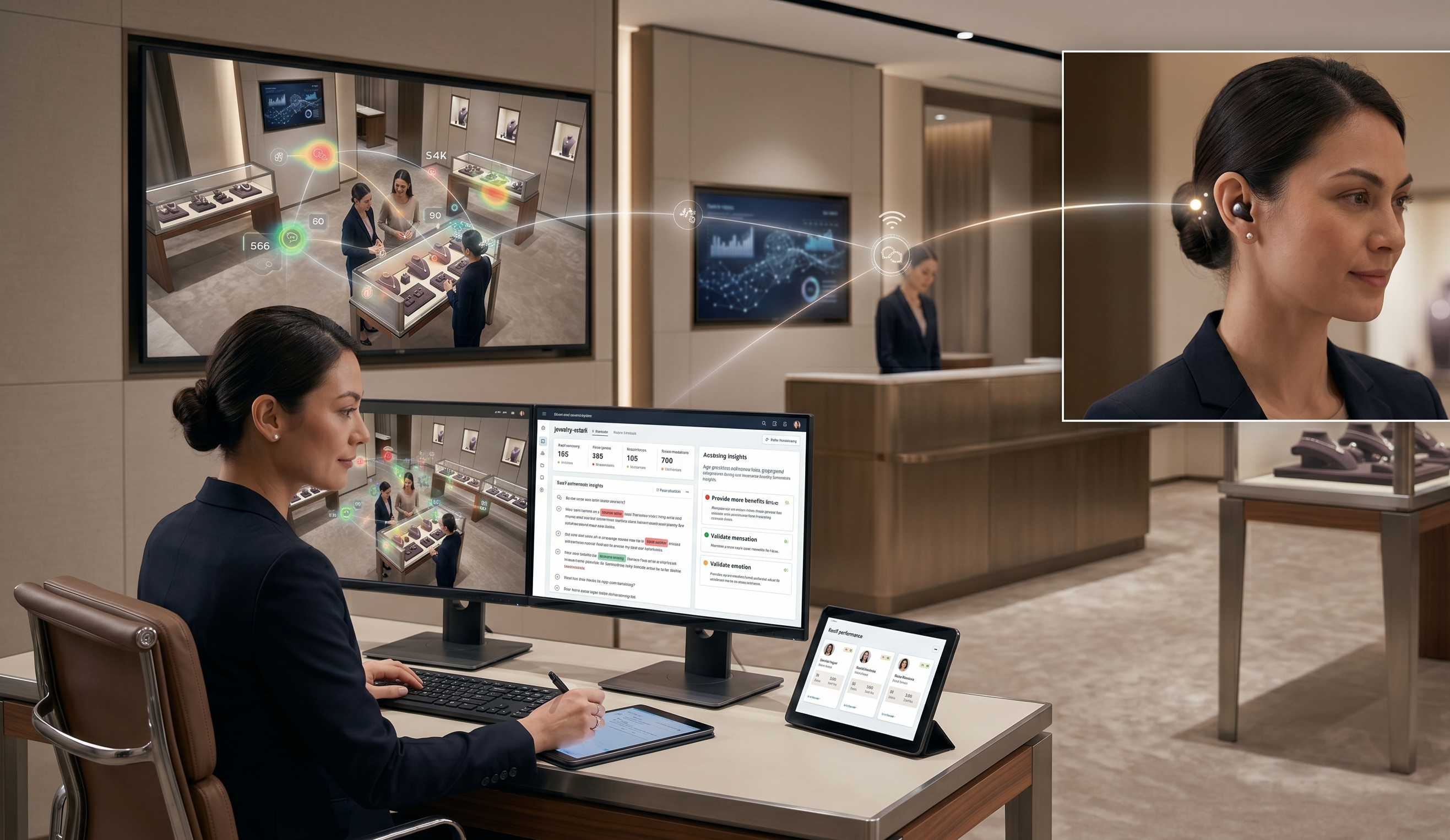
TABLE OF CONTENTS
1. The Manager's Impossible Task
Running a jewellery store as a manager means being pulled in every direction simultaneously.
There are stock levels to monitor. Supplier relationships to manage. Visual merchandising to maintain. Rotas to plan. Customer complaints to handle. Administration that never quite gets finished.
And somewhere in the middle of all of that, there is the most important job of all: making sure every associate on the floor is having the best possible conversation with every customer who walks in.
That last responsibility is the one that most jewellery retail managers quietly know they are not fulfilling as well as they would like. Not because they do not care about it, but because the demands of the role make it genuinely impossible to be present for every customer interaction.
A manager can observe a few conversations each day. On a good day, perhaps five or six. On a busy day, considerably fewer. The rest of the floor activity happens beyond their direct supervision, with no record, no feedback, and no way to know whether it is meeting the standard the store needs.
In-store voice intelligence changes the economics of management entirely.
2. What Happens on the Floor When No One Is Watching
Most jewellery retail managers already have a sense of this, even if it is uncomfortable to say out loud.
Associate performance changes when a manager is watching. The energy lifts. The questions get better. The closing attempts become more confident. Every experienced retail manager has seen this dynamic play out, and most accept it as an unavoidable feature of the job.
The problem is not that associates are being dishonest. It is that performance without observation tends to drift. Without consistent feedback grounded in real evidence, associates fall back on their comfort zones. They default to the approaches they feel easiest with rather than the approaches that work best. They avoid the closing moments that feel risky. They let difficult objections slide rather than leaning into them.
Over time, that drift accumulates into a performance gap between what your store is capable of and what it is actually delivering. And because most of the floor activity that drives that gap is invisible to management, it is also invisible to correction.
3. How AI Gives Managers Eyes Across the Entire Floor
An in-store voice intelligence platform does not replace the manager. It extends what the manager is able to see, know, and act on.
A manager reviewing the platform's daily summary does not need to have been present for a single conversation to have a clear, accurate picture of what happened on the floor that day. They know which associate handled a price objection well and which one let it derail the sale. They know which customer came in with a high-intent signal that was not acted on. They know where the coaching opportunities are and exactly what those conversations sounded like.
4. The Shift From Reactive to Proactive Coaching
One of the most significant changes that in-store voice intelligence creates for jewellery retail managers is the shift from reactive to proactive coaching.
Traditional floor management is almost entirely reactive. A manager notices a problem, addresses it, and moves on. The feedback loop is slow because the observation opportunities are limited. An associate might repeat the same conversational mistake dozens of times before a manager happens to witness it and intervene.
With conversation intelligence, that changes. The platform identifies patterns across interactions rather than relying on a manager to catch isolated moments. If an associate is consistently losing sales at the same point in the conversation, the data surfaces that pattern within days rather than weeks. The manager can address it specifically, with real conversation examples, before it becomes an entrenched habit.
Coaching moves from occasional and general to continuous and specific. And continuous, specific coaching is the kind that actually changes performance.
5. What Evidence-Based Coaching Looks Like in Practice
The difference between traditional coaching and evidence-based coaching in a jewellery retail environment is significant, and it is worth being concrete about what it looks like.
In a traditional coaching session, a manager might say something like: "I think you need to work on handling price objections more confidently. Try to stay calm and reinforce the value of the piece."
That guidance is well-intentioned. But it is vague. The associate hears it, nods, and has limited ability to translate it into a different behavior the next time a price concern comes up.
In an evidence-based coaching session built on conversation intelligence, the same issue looks completely different. The manager says: "In three conversations this week, when a customer mentioned the price was higher than expected, the conversation ended within two minutes. Here is what one of those exchanges sounded like. Now here is a conversation from your colleague where the same objection came up and she redirected it by shifting to the story of the piece. Listen to the difference."
That is a coaching conversation that changes behavior. The associate has a specific, real example of what went wrong and a specific, real example of what better looks like. The learning is grounded, tangible, and immediately applicable.
6. Managing Multiple Associates Across Shifts and Locations
For jewellery retailers managing more than one associate, more than one shift, or more than one location, the value of in-store voice intelligence multiplies quickly.
A single store manager trying to maintain quality across a team of five or six associates across morning and evening shifts is already stretched. The platform gives them visibility across all of it, not just the interactions they happened to be present for.
For an area manager or retail director overseeing multiple jewellery store locations, the challenge is even greater. Visiting each store regularly is time-consuming. Knowing what is really happening on the floor of each location between visits is nearly impossible using traditional observation methods.
Conversation intelligence makes that visibility available from anywhere. A director can review performance data across all locations, identify which stores are underperforming and why, and direct coaching resource precisely where it is most needed, without needing to be physically present to know what is going on.
7. Developing Associates Faster
One of the practical outcomes of AI-assisted coaching that jewellery retail managers notice quickly is how much faster their associates develop.
The traditional development arc for a jewellery sales associate is long. Building the instincts, the conversational confidence, and the product knowledge to perform consistently at a high level typically takes one to two years, sometimes longer.
Evidence-based coaching compresses that timeline significantly. An associate who receives specific, data-driven feedback on their real conversations every week develops faster than one who receives general guidance every month. The feedback loop is tighter, the learning is more targeted, and the progress is more visible, to the associate as well as to the manager.
New hires who would previously have taken six months to reach a productive performance level can get there in three. Experienced associates with specific gaps can close those gaps in weeks rather than months. The cumulative effect on store performance is substantial.
8. The Manager Who Knows Everything That Happened Today
There is a version of jewellery retail management that most store managers have never experienced. A version where they end each day knowing exactly what happened on their floor, not just in the transactions that completed but in every customer conversation that shaped those outcomes.
Where they know which associates had strong days and which ones need support. Where their coaching is grounded in real evidence rather than memory and observation. Where the gap between the standard they want and the standard they are delivering closes week by week.
In-store voice intelligence makes that version of management available. It does not eliminate the complexity of running a jewellery store. But it gives the manager something they have never had before: genuine visibility into the most important activity happening in their business every single day.
"Great coaching requires great information. In-store voice intelligence makes sure you always have it."
"Want to see how in-store voice intelligence gives jewellery retail managers complete visibility across every conversation on the floor?Book a free demo
and we will show you exactly what the platform surfaces."

About Jinn Research
Jinn Research studies what happens in real sales conversations on the retail floor. Our insights come from showroom, test drive and follow-up conversations captured by Jinn and scored from greeting to close.