Why Your Best Jewellery Sales Associate's Techniques Are Never Being Replicated Across Your Team

TABLE OF CONTENTS
1. Every Jewellery Store Has One
You know exactly who she is.
She walks onto the floor and customers gravitate toward her. She has a way of making people feel comfortable, unhurried, and genuinely understood. She asks the right questions at the right moment. She handles price concerns without flinching. She closes sales that other associates let walk out the door.
Her conversion rate is nearly double the team average. Her average transaction value is consistently higher. Customers ask for her by name when they return.
She is your best asset and she is also, without you realising it, your biggest operational problem.
Not because of anything she does wrong. But because everything she does right lives entirely inside her head, and you have no reliable way to get it out.
2. The Knowledge Trap in Jewelry Retail
In most jewellery stores, sales performance knowledge is almost entirely tacit. It lives in the instincts, habits, and conversational reflexes of individual associates accumulated through experience, never formally captured, and therefore never truly transferable.
Your top performer knows how to read a customer within the first thirty seconds. She knows when to talk and when to let silence do the work. She knows which questions open people up and which ones create resistance. She knows how to move from product exploration to purchase conversation without it ever feeling like a push.
None of that knowledge was formally taught. None of it is written down. And none of it is being systematically passed on to the rest of your team.
This is the knowledge trap and it affects nearly every jewellery retailer operating today. The performance gap between your best associate and your average associate is not a talent gap. It is an intelligence gap. The knowledge exists in your store. It is just locked in one person.
3. What Happens When That Person Leaves
The fragility of this situation becomes most visible when a top performer moves on.
Her sales numbers disappear from your monthly report. Her loyal customers notice the difference. Her replacement, however talented starts from scratch, without access to the conversational knowledge that made her effective.
In jewellery retail, where customer relationships are long-term and high-value, the departure of a top associate can take months to recover from not just in revenue, but in customer experience quality and team morale.
And yet most jewellery retailers have no system for capturing and preserving that knowledge before it walks out the door.
4. Why Traditional Coaching Does Not Solve This
The instinctive response to a performance gap is more training. Shadowing. Role play. Team huddles. General guidance about rapport-building and objection handling.
These approaches are not without value but they have a fundamental limitation. They are based on what managers can observe, remember, and articulate from their own experience. They are not based on actual data from the conversations happening on your floor right now.
Shadowing gives a new associate a few hours of observation. It cannot replicate the thousands of micro-decisions your top performer has refined over years. Role play is artificial; it cannot capture the real emotional dynamics of a high-consideration jewellery purchase. General coaching guidance, without specific conversational evidence, lands vaguely and fades quickly.
The result is that the performance gap between your best associate and the rest of your team persists not because your other associates lack ability, but because the system for transferring knowledge simply does not work well enough.
5. How In-Store Voice Intelligence Solves the Replication Problem
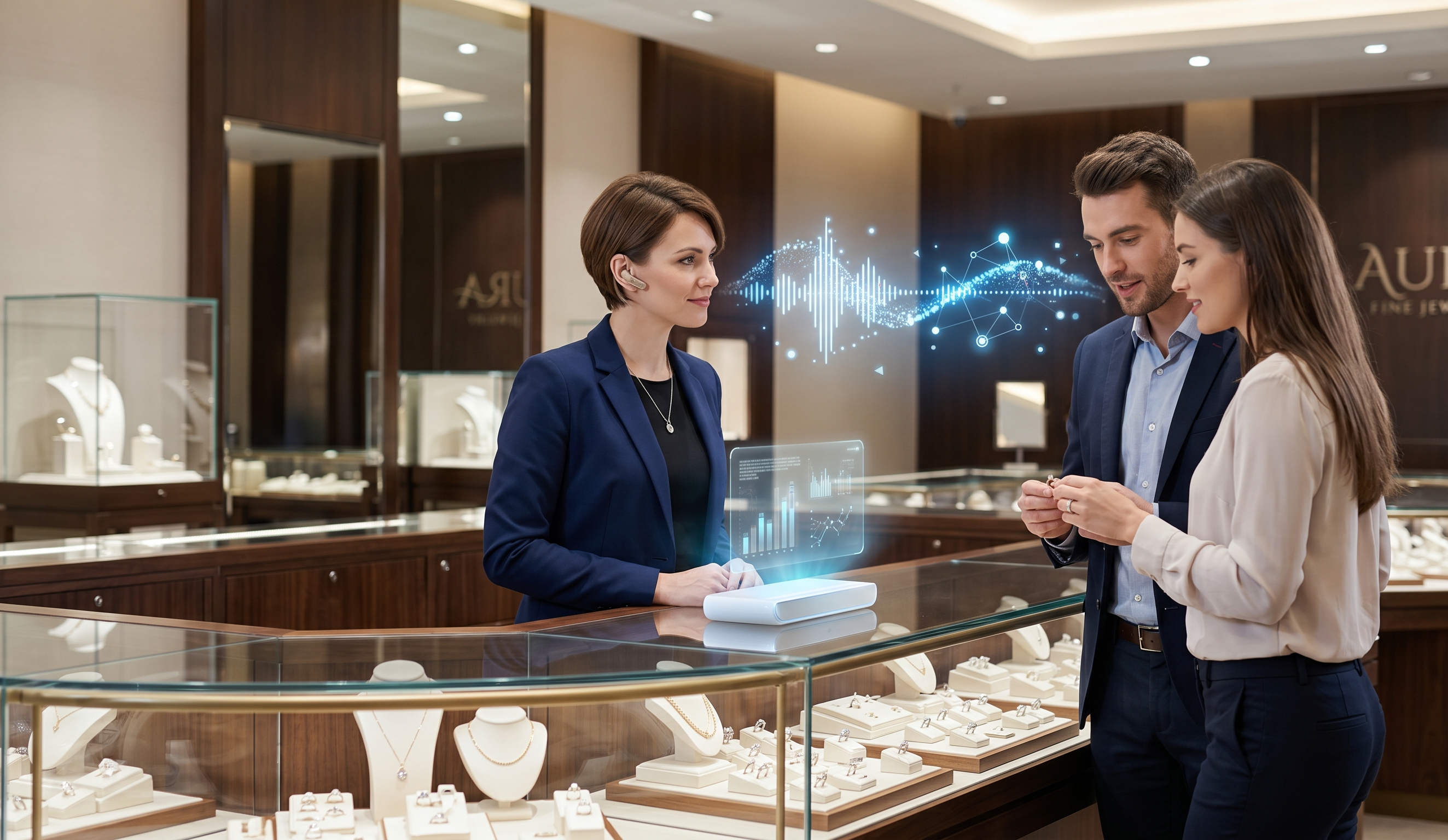
An in-store voice intelligence platform does what no training manual, shadowing program, or coaching session can do on its own: it captures the actual conversations your top performer is having and extracts the specific techniques that make them work.
Audio capture devices placed openly across your sales floor record every customer interaction. The platform's AI analyses those conversations and identifies the patterns that are statistically connected to positive sales outcomes, the specific questions asked, the language used when handling objections, the way value is built around a piece, the moment and manner of the closing pivot.
Over time, a clear picture emerges of what a winning jewellery sales conversation looks like in your specific store drawn entirely from evidence, not assumption.
That picture can then be translated directly into coaching. Not generic guidance, but specific, evidence-based instruction grounded in real examples from your own floor.
6. From One Person's Instinct to the Whole Team's Capability
The transformation this creates is significant.
A new associate no longer has to develop effective conversational techniques through years of trial and error. She has access, from the start, to a coaching program built on the proven approaches of your best performers with real conversation examples that illustrate exactly what good looks like in your store.
An experienced associate who is underperforming in a specific area, say, handling price objections or closing high-value custom orders can receive targeted coaching on that exact skill, drawn from conversations where that skill was executed well by a colleague.
A manager who cannot be on the floor for every interaction can still coach with confidence, because the data tells them what is happening in every conversation, not just the ones they happened to observe.
The knowledge that used to live in one person's head becomes a shared, growing, organizational asset. Your best associate's techniques stop being her personal secret and become the team's standard operating approach.
7. What the Platform Surfaces About Your Top Performers
When in-store conversation intelligence analyses your highest-converting associates' interactions, it typically reveals several consistent patterns that separate them from average performers:
• Earlier and more specific discovery questions: Top performers ask questions that surface the customer's emotional motivation, the occasion, the relationship, the significance of the purchase earlier and more naturally in the conversation.
• More confident value narration: When discussing price, top performers do not retreat or apologize. They lean into the story of the piece, its craftsmanship, provenance, or meaning and connect that story to the customer's stated motivation.
• Better objection timing: High performers do not rush to counter an objection. They acknowledge it, validate the customer's feeling, and then redirect in a sequence that feels natural rather than scripted.
• Cleaner closing language: The transition from consideration to purchase in a top performer's conversation is smooth and low-pressure. The language they use at that moment is specific, repeatable, and learnable.
All of these patterns can be identified, documented, and taught once you can see the conversations they come from.
8. The Compounding Effect of Captured Knowledge
One of the most valuable aspects of in-store voice intelligence is what happens to your coaching capability over time.
In the first month, you begin to see what your top performers are doing differently. In the third month, you have enough data to build a structured, evidence-based coaching program. By six months, your team's average performance has moved meaningfully and you have a library of real conversation examples that make ongoing training faster and more effective.
Each month of conversation data makes your coaching richer. Each coaching improvement raises the floor of your team's performance. The gap between your best associate and your average associate narrows not because your star performer is held back, but because the rest of the team is brought up.
That is not just a performance improvement. It is a structural competitive advantage that builds over time and becomes harder for competitors to replicate.
9. The Knowledge Is Already There. Capture It.
Your top jewellery sales associate is demonstrating excellence on your floor every day. The techniques that make her exceptional are present in every conversation she has audible, analyzable, and transferable.
The only thing standing between that knowledge and your whole team having access to it is a system for capturing and learning from it.
In-store voice intelligence is that system.
"Your best associate's techniques should not retire when she does. Start capturing them today."
"Want to see how in-store voice intelligence captures and transfers your top performers' techniques across your jewellery team?Book a free demo
and we will show you exactly how it works."

About Jinn Insights
Jinn Insights studies what happens in real sales conversations on the retail floor. Our insights come from showroom, test drive and follow-up conversations captured by Jinn and scored from greeting to close.
Share Your Thoughts
Join the conversation and let us know what you think