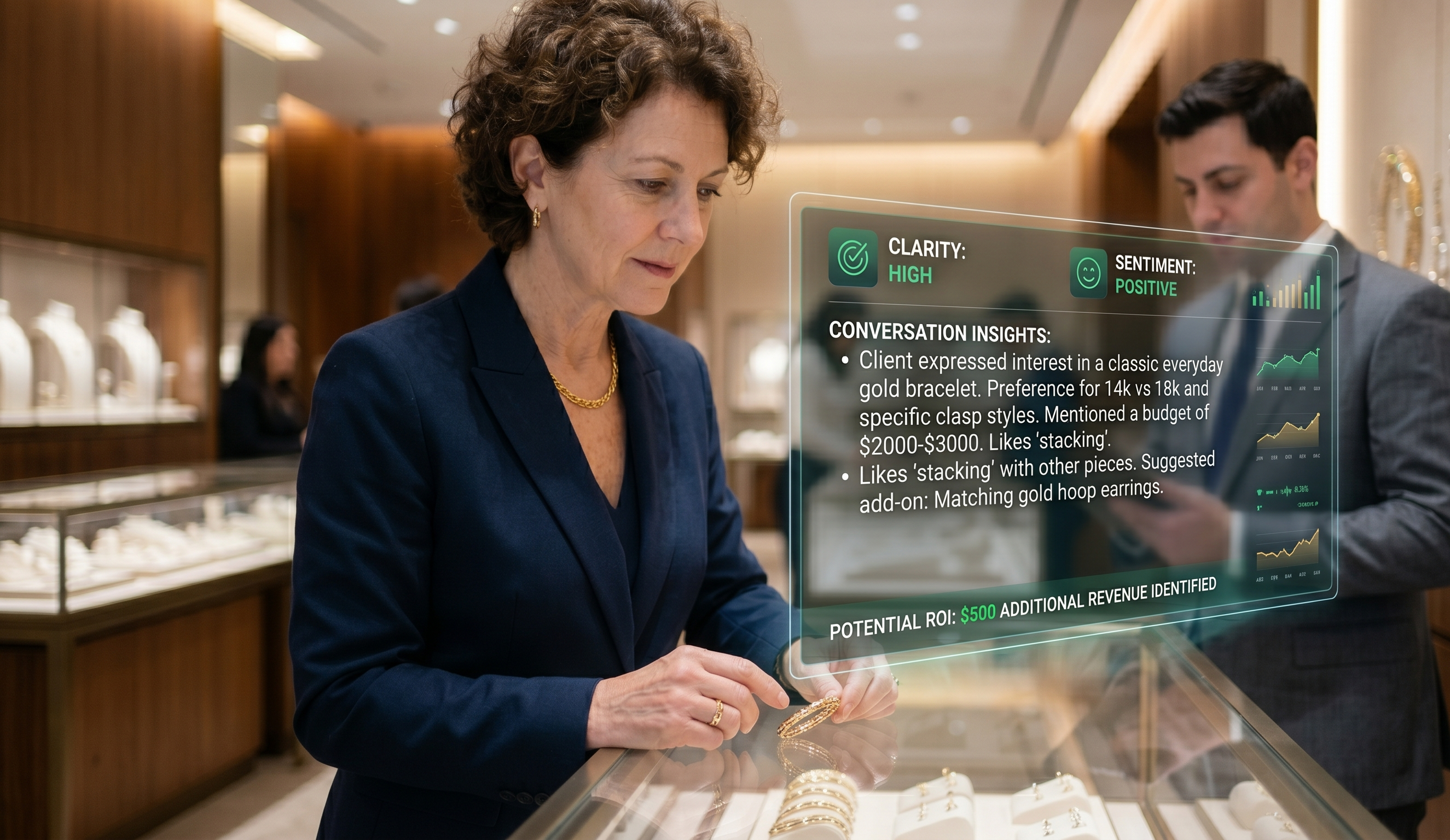
Your Customers Are Telling You What to Stock: How AI Captures In-Store Demand Signals

TABLE OF CONTENTS
1. The Most Accurate Demand Signal in Jewellery Retail Is Being Ignored
Every jewellery retailer wants to stock the right products. The pieces that customers respond to immediately. The price points that match actual buying appetite. The styles that generate excitement on the floor rather than sitting in cases for months waiting for the right customer to arrive.
Getting that right is one of the most commercially important decisions a jewellery business makes. Get it right and your floor is alive with customer interest, your stock turns quickly, and your margins hold. Get it wrong and capital is tied up in pieces that generate little conversation, buying budget is wasted on products that underperform, and the customers who walk in looking for something specific leave without finding it.
Most jewellery retailers try to solve this problem with a combination of historical sales data, trade show observation, supplier recommendations, and a general sense of where market trends are heading. These are reasonable inputs. But they share a significant limitation.
None of them tell you what the customers who walked into your store this week actually asked for.
That information exists. It is being spoken aloud on your sales floor every single day. And in the vast majority of jewellery stores, it disappears the moment the conversation ends.
2. What Customers Actually Say When They Cannot Find What They Want
Think about what happens when a customer comes into your jewellery store looking for something your current range does not carry.
They describe what they have in mind. They mention the style, the occasion, the price range they are comfortable with. Your associate listens, apologises that you do not have exactly that, and offers the nearest alternative. The customer thanks them, considers the alternative briefly, and in many cases leaves without making a purchase.
That interaction contains some of the most valuable inventory intelligence your business could have. A specific description of a product that a real customer with genuine purchase intent wanted to buy from you but could not. Multiply that across your entire team over a month and you have dozens, possibly hundreds, of specific demand signals pointing directly at the gaps in your current range.
Right now, none of that intelligence reaches your buying decisions. The associate remembers some of it briefly. The rest is gone. Your next buying cycle is informed by last season's sales data rather than by what customers are asking for right now.
In-store voice intelligence changes that entirely.
3. How the Platform Captures Demand Signals
An in-store voice intelligence platform captures every customer conversation on your sales floor and analyses it for demand intelligence. This happens continuously, across every interaction, without requiring your associates to do anything differently.
The platform's AI identifies the moments in conversations where customers describe what they are looking for, express interest in specific product categories or styles, ask for items you do not currently stock, or indicate that your current range is not quite meeting their needs.
Those moments are tagged, categorised, and aggregated across your full conversation history. Over days and weeks, a clear pattern of demand signals emerges that no individual observation could have detected.
The platform surfaces questions like: which product categories are generating the most customer enquiries relative to actual purchases? Which price points are customers asking about that your current range does not adequately serve? Which styles are customers describing that do not appear in your current collection? Which specific requests are coming up repeatedly across different associates and different days?
The answers to those questions are not projections or market research estimates. They are real demand data from the actual customers who walked into your store.
4. The Inventory Decisions This Intelligence Changes
When jewellery buyers and merchandising managers have access to in-store demand signal data, several inventory decisions change in ways that directly improve commercial performance.
• Gap identification becomes precise: Rather than a vague sense that a particular category might be underserved, the platform provides specific evidence of what customers are asking for that your range does not include. The decision to introduce a new product line or expand an existing one is grounded in documented customer demand rather than instinct.
• Buying confidence increases: One of the risks in jewellery buying is investing in a new style or category that does not resonate with your specific customer base. Demand signal data reduces that risk significantly. If the data shows that customers in your store have been asking for a particular style repeatedly over the past three months, buying into that style is a much more confident decision than buying based on trade show trends alone.
• Overstock is reduced: Products that are occupying floor space and buying budget but generating minimal customer conversation are identifiable in the data before their slow sales figures become obvious. Recognizing those products earlier and adjusting buying decisions accordingly reduces the capital tied up in slow-moving stock.
• Range alignment improves over time: With every buying cycle informed by conversation demand data, the alignment between your product range and your customers' actual preferences improves. The floor becomes a more accurate reflection of what your specific customer base wants, which creates a self-reinforcing cycle of stronger customer engagement and higher conversion.
5. The Difference Between What Sold and What Was Wanted
This distinction is at the heart of why conversation demand data is so much more valuable than sales data alone for inventory decisions.
Sales data tells you what customers chose from the options you presented them. It does not tell you what they wanted that you did not have. It does not capture the customer who asked about a style you do not carry and left without buying. It does not record the repeated requests for a price point you are underserving. It does not reflect the demand that existed but went unmet.
Conversation data fills that gap. It captures not just the purchases that completed but the desires that were expressed, the interests that were shown, and the needs that went unmet. It gives you a complete picture of customer demand rather than just the fraction of that demand that your current range was able to satisfy.
For a jewellery buyer, the difference between those two pictures can be significant. Sales data shows you how well your current range is performing. Conversation data shows you how much better your range could perform if it more precisely reflected what your customers are actually looking for.
6. Demand Signals Across Different Customer Segments
One of the more nuanced outputs of in-store demand signal analysis is what it reveals about different customer segments and how their product preferences differ.
Customers shopping for engagement rings have different needs and express different preferences than customers buying anniversary gifts. Customers in the two hundred to five hundred pound range ask for different things than customers in the two thousand pound and above range. Customers who mention they have been to other stores have different unmet needs than customers who are visiting your store first.
When conversation intelligence segments demand signals by customer type and purchase context, the inventory intelligence becomes even more actionable. Not just "there is demand for this style" but "there is demand for this style specifically from customers in this purchase context at this price point." That level of specificity allows buying decisions to be targeted in ways that general sales data cannot support.
7. From Reactive to Proactive Inventory Management
The shift that in-store demand signal data enables is a shift from reactive to proactive inventory management.
Reactive inventory management responds to what has already sold, or failed to sell. It is inherently backward-looking. By the time the sales data makes a gap in your range obvious, you have already lost the sales that gap was costing you, and the lead time to fill it may mean you continue losing those sales for another season.
Proactive inventory management responds to what customers are currently asking for, before those requests accumulate into obvious underperformance. It identifies gaps when they are emerging rather than after they have already cost the business revenue. It allows buying decisions to be made ahead of demand rather than in response to it.
For jewellery retailers operating in a market where product trends move quickly and customer tastes evolve continuously, that proactive capability is a meaningful commercial advantage.
8. The Stock Your Customers Are Already Asking For
There is a version of your jewellery range that your customers are already telling you they want. They are describing it in conversations on your floor every week. They are asking for the styles, the price points, and the product categories that would make them spend more, return more often, and recommend your store to others.
Right now, most of that information is disappearing into the air. In-store voice intelligence captures it, organizes it, and puts it directly into the hands of the people making your buying and merchandising decisions.
The result is a product range that feels more responsive, more relevant, and more precisely aligned with what the people who actually walk through your door are looking for.
"Your customers are already telling you what to stock. In-store voice intelligence makes sure you are listening."
"Want to find out what demand signals your in-store conversations are already generating?Book a free demo
and we will show you the inventory intelligence your sales floor is producing every day."

About Jinn Insights
Jinn Insights studies what happens in real sales conversations on the retail floor. Our insights come from showroom, test drive and follow-up conversations captured by Jinn and scored from greeting to close.
Share Your Thoughts
Join the conversation and let us know what you think