In the Showroom: What 445 Sales Conversations Reveal About Why Shoppers Buy
Only 2 in 100 shoppers walked out over price. Six findings from 445 recorded jewelry store conversations, and what they mean for your sales floor.
Your point-of-sale system tells you who bought. It can’t tell you why the other four in five didn’t.
That answer lives in the conversation between a shopper and a sales associate. In most stores, nobody but the associate ever hears it. A manager might catch a few minutes of the floor on a busy Saturday. Mystery shoppers capture a handful of visits a quarter. Everything else disappears the moment the shopper walks out.
In the Showroom is a new series from Jinn Research about what actually happens in those conversations. Each post takes one pattern from real showroom data and turns it into something a store leader can act on. This first post covers the headline findings. The posts that follow go deeper into each one.
TABLE OF CONTENTS
1. Key takeaways
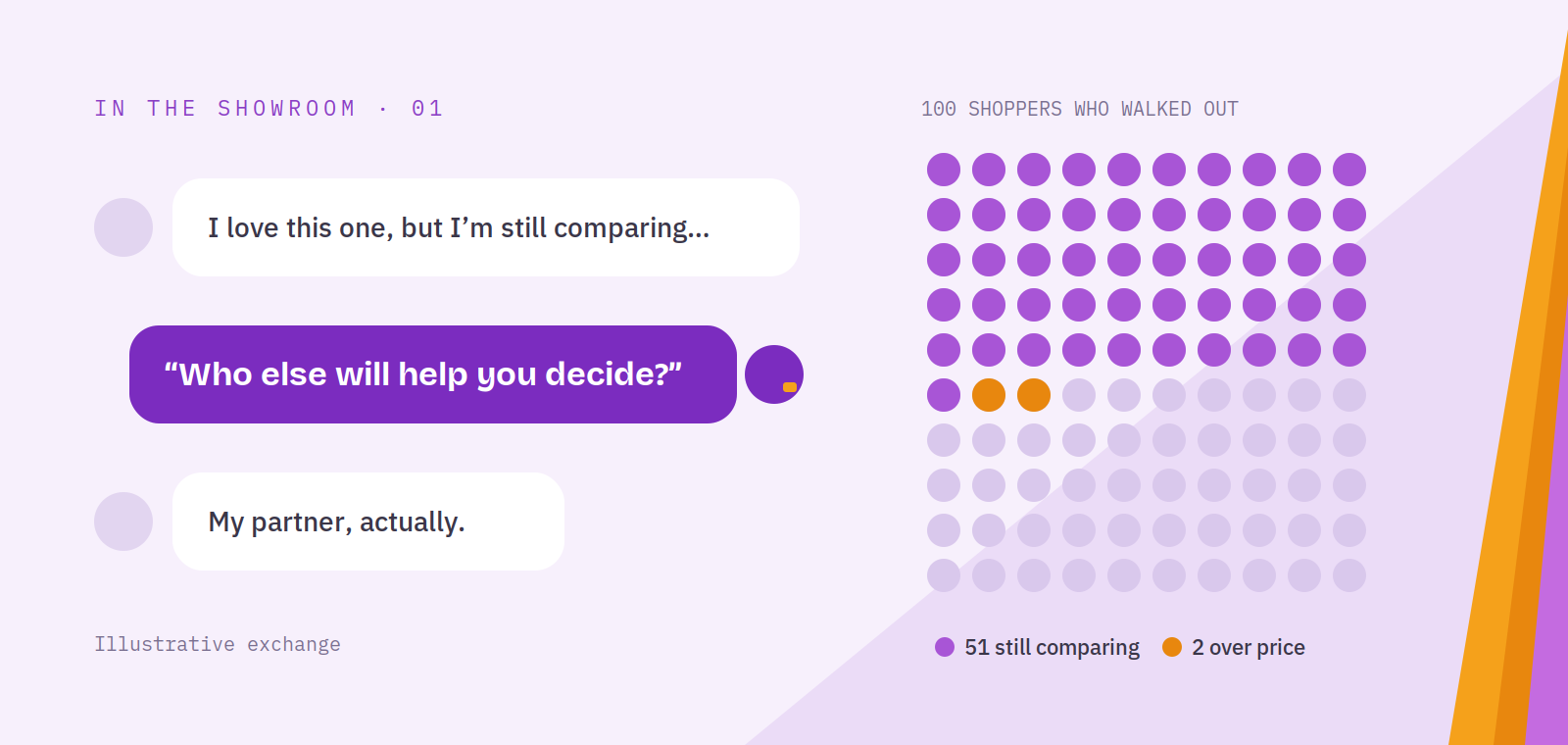
- Price is rarely the reason. Only 2% of shoppers who walked out said the price was above their budget. 51% were still comparing.
- The close decides the sale. 41% bought when associates did three closing steps, vs 14% when they did none.
- One question matters. Asking “Who else will help you decide?” went with twice the purchase rate.
- Follow-ups leak. Only 8% of engaged shoppers who walked out left a name or number.
- “Not in stock” isn’t the end. 23% still bought when offered an alternative. None did without one.
2. What we listened to
Over less than four weeks this fall, sales associates at two jewelry retailers wore Jinn badges on the floor. Every conversation was transcribed and scored, from the greeting and discovery through product, objections and the close. We also captured how each visit ended: a purchase, a shopper who left interested, or a shopper who was lost.
We call the two retailers Brand A and Brand B. Brand A recorded 57 conversations in 2 stores. Brand B recorded 388 in 5 stores, and for most of its findings we look at the 202 conversations that lasted 15 minutes or more, since shorter visits were usually quick browsing.
3. Six things we heard on the floor
FINDING 01Shoppers rarely walk out over price
Ask most store leaders why shoppers leave without buying, and price comes up first. In the conversations, it almost never did.
Brand A told the same story: 42% were still comparing, and not one shopper named price as the main reason. A shopper who is still comparing hasn’t said no. They just haven’t been helped to say yes.
FINDING 02Sales are won at the close
We looked at three things associates do at the end of a conversation, and how often shoppers bought when they did them.
Brand A showed the same pattern: 35% bought after a clear closing attempt, compared with 9% without one.
FINDING 03One question went with twice the purchase rate
Jewelry is often a shared decision. The associates who sold more found that out early.
Who else will help you decide?
Brand A: 13 asked, 44 not · Brand B: 37 asked, 165 not
Naming the other decision-maker gives the associate a next step: a video call, a hold, or a return visit together.
FINDING 04Buyers stayed twice as long
At Brand B, the median conversation that ended in a purchase lasted 29 minutes. For shoppers who left without buying, it was 14 minutes.
Seating a shopper and narrowing to a focused shortlist keeps an engaged buyer in the conversation.
FINDING 05Most follow-ups never had a chance
About three in four engaged shoppers left needing a follow-up rather than lost: 77% at Brand B and 75% at Brand A. That’s real demand still on the table. But most of it was unreachable.
FINDING 06When it’s not on the shelf, the alternative saves the sale
More than one in four Brand B conversations (105 of 388) involved a request for something not in ready stock. Usually it was a specific design, a ring size or a diamond shape, not a new category. What the associate said next made the difference.
Brand B, all 388 conversations
4. What this means for your stores
None of these patterns calls for a new product line, a price cut or a bigger team. They point to small habits in the conversation that are easy to coach. Three to start with:
Make the close a routine, not a moment. Narrow to two pieces, recommend one with a reason, then ask to buy or hold. Before the shopper leaves, ask who else is deciding and agree on what happens next.
Never let a walk-out leave empty-handed. Ask for a name and number when you share photos or a quote, and send the shortlist the same day.
Always have an answer for “not in stock.” Offer the nearest ready piece, plus a date for a special order.
The harder part is knowing whether it’s happening. Most leaders can’t say how often their associates ask who’s deciding, or why their walk-outs really left. That’s the gap this series, and Jinn, is built to close.
5. A note on the numbers
These findings show what tended to go together with buying. They don’t prove that one thing caused another. Longer conversations, for example, naturally include more of the closing steps. At Brand B, after allowing for store, product and conversation length, each extra closing step still went with roughly 1.5 times higher odds of a purchase.
Some groups are small, such as the 32 conversations where associates did all three closing steps. We’ll keep sharpening these numbers as more stores and brands join. Brand and store names have been removed, and the dollar figure is converted from the ticket sizes shoppers stated.
6. Coming up in the series
Over the next few weeks, In the Showroom takes each finding in turn.

About Jinn Insights
Jinn Insights studies what happens in real sales conversations on the retail floor. Our insights come from showroom, test drive and follow-up conversations captured by Jinn and scored from greeting to close.
Share Your Thoughts
Join the conversation and let us know what you think